D programming language
Presenter : 鄧仕榆、賴柏瑜
王議偉、陳殿善
Introduction


Generics
							template Foo (T)
								if(is(T == int)) // constraint
							{
							    T number;
							}
Generative
							struct A{
								int a;
								mixin(bitfields!(
									unit, "x", 2,
									int, "y", 3,
									uint, "z", 2,
									bool, "flag", 1));
							}

							A obj;
							obj.x = 2;
							obj.z = obj.x;
Contract
							in
							{
								... contract preconditions ...
							}
							out (result)
							{
								... contract postconditions ...
							}
							do
							{
								... code ...
							}
Associative Arrays
								int[string] aa = ["hello":3, "world":4];

								aa["hello"] = 5;  // set value associated with key "hello" to 5
								int value = aa["hello"];  // lookup value from a key
								assert(value == 5);
Static Typing With Inference
								void main(){
									// type:double[]
									auto arr = [1, 2, 3.14, 5.1, 6];
									// type:int[string]
									auto dictionary = ["one": 1, "two": 2, "three": 3];

									auto x = min(arr[0], dictionary["two"]);
								}

								auto min(T1, T2)(T1 lhs, T2 rhs){
									return rhs < lhs ? rhs : lhs;
								}
Resource Management
								import std.stdio, core.stdc.stdlib
								class Widget{    }

								void main(){
									auto w = new Widget;    //automatic

									//Code is executed in any case upon scope exit
									scope(exit){ writeln("Exiting main"); }

									auto p = malloc(10);    //explicit C style
									if(p)free(p);
								}
Slices
							auto filename = "etc/c/zip d"
							auto path = filename[0..6];    //"etc/c/"
							auto name = filename[6..9];    //"zip"
							auto ext = filename[10..11];    //"d"
Feature
Inline Assembler
						asm{
							assembler language
						}
Assert
assert(expression);
Contract Programming
								in
								{
									contract preconditions
								}
								out(result)
								{
									contract postconditions
								}
								do
								{
									code
								}

Invariant
specify characteristics of a
class or
struct
that must always be true
						invariant
						{
							assert(expr1);
							assert(expr2);
							...
						}
Invariant Example
							class Date
							{
								int day;
								int hour;
								this (int d, int h){
									day = d;
									hour = h;
								}
								invariant
								{
									assert(1 <= day && day <=31);
									assert(0 <= hour && hour < 24);
								}
							}
UFCS Example
						writeln(evens(divide(multiply(values, 10), 3)));

						values.multiply(10).divide(3).evens.writeln;
Thread Local Storage (TLS)
Thread Local Storage (TLS)
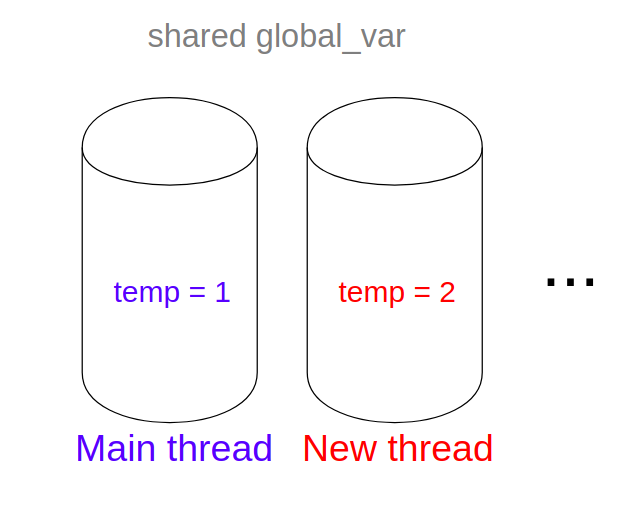
Thread Local Storage (TLS)
							in main thread : temp = 1, temp address is 7F7E4E79C740
							in sub  thread : temp = 2, temp address is 7F7E4D68A580
							in main thread : temp = 1, temp address is 7F7E4E79C740
							in sub  thread : temp = 2, temp address is 7F7E4D68A580
							in main thread : temp = 1, temp address is 7F7E4E79C740
Mutex
								mtx.lock_nothrow();

								counter += 1;

								mtx.unlock_nothrow();
Message Passing
Message Passing in C/C++
								int main(int argc , char *argv[]) //server
								{
									//socket的建立
									char inputBuffer[256] = {};
									char message[] = {"Hi,this is server.\n"};
									int sockfd = 0,forClientSockfd = 0;
									sockfd = socket(AF_INET , SOCK_STREAM , 0);

									if (sockfd == -1){
										printf("Fail to create a socket.");
									}

									//socket的連線
									struct sockaddr_in serverInfo,clientInfo;
									int addrlen = sizeof(clientInfo);
									bzero(&serverInfo,sizeof(serverInfo));

									serverInfo.sin_family = PF_INET;
									serverInfo.sin_addr.s_addr = INADDR_ANY;
									serverInfo.sin_port = htons(8700);
									bind(sockfd,(struct sockaddr *)&serverInfo,sizeof(serverInfo));
									listen(sockfd,5);

									while(1){
										forClientSockfd = accept(sockfd,(struct sockaddr*) &clientInfo, &addrlen);
										send(forClientSockfd,message,sizeof(message),0);
										recv(forClientSockfd,inputBuffer,sizeof(inputBuffer),0);
										printf("Get:%s\n",inputBuffer);
									}
									return 0;
								}
								int main(int argc , char *argv[]) //client
								{
									//socket的建立
									int sockfd = 0;
									sockfd = socket(AF_INET, SOCK_STREAM , 0);

									if (sockfd == -1){
										printf("Fail to create a socket.");
									}

									//socket的連線
									struct sockaddr_in info;
									bzero(&info,sizeof(info));
									info.sin_family = PF_INET;

									//localhost test
									info.sin_addr.s_addr = inet_addr("127.0.0.1");
									info.sin_port = htons(8700);

									int err = connect(sockfd,(struct sockaddr *)&info,sizeof(info));
									if(err==-1){
										printf("Connection error");
									}

									//Send a message to server
									char message[] = {"Hi there"};
									char receiveMessage[100] = {};
									send(sockfd,message,sizeof(message),0);
									recv(sockfd,receiveMessage,sizeof(receiveMessage),0);

									printf("%s",receiveMessage);
									printf("close Socket\n");
									close(sockfd);
									return 0;
								}
Message Passing in D
							void workerFunc(Tid tid) {
								int value = 0;
								while (value >= 0) {
									value = receiveOnly!int();
									auto result = to!int(value) * 5;
									tid.send(result);
								}
							}

							void main() {
								Tid worker = spawn(&workerFunc,thisTid);

								foreach (value; 5 .. 10) {
									worker.send(value);
									auto result = receiveOnly!int();
									writefln("main sent: %s, received: %s", value, result); // value = 5 ,result = 30 ...
								}

								worker.send(-1);
							}
Message Passing in D
								void workerFunc(Tid tid)
								{
								   Thread.sleep(dur!("secs")( 5 ),);
								   tid.send("hello");
								}

								void main()
								{
									spawn(&workerFunc,thisTid);

									writeln("Waiting for a message");
									bool received = false;
									while (!received)
									{
										received = receiveTimeout(dur!("secs")( 1 ),
										(string message){
											writeln("received: ", message);
										});

										if (!received)	writeln("... no message yet");
									}
								}
								Waiting for a message
								... no message yet
								... no message yet
								... no message yet
								... no message yet
								received: hello
Fiber
							import std.stdio;
							import core.thread : Fiber;

							void foo() {
								writeln("Hello");
								Fiber.yield();
								writeln("World");
							}

							int main(){

								auto f = new Fiber(&foo);
								f.call(); // prints Hello
								f.call(); // prints World

								return 0;
							}
Parallel
								import std.stdio;
								import core.thread;
								import std.parallelism;

								struct Student {
									int number;

									void sleepOperation() {
										Thread.sleep(1.seconds);
										writefln("The work on student %s has ended", number);
									}
								}

								void main() {
									auto students =
										[ Student(1), Student(2), Student(3), Student(4) ];

									foreach (student; parallel(students)) {	//	parallelism
										student.sleepOperation();
									}
								}
Garbage Collection
							void main() {
								import core.memory;
								import std.stdio;

								GC.disable;
								writeln("Goodbye, GC!");
							}
Class Template
C++
							template < class T>
							class Foo{
								T x;
								Foo(T init){ this.x = init; }
							};
D
								class Foo(T){
									T x;
									this(T init){ this.x = init; }
								}
Function Template
C++
							template < class T >
							T Foo(T t){
								return t;
							};
D
							T Foo(T)(T t){
								return t;
							}
Grouping templates with the same parameters
C++
							template< class T, class U>
							class Foo_Bar { ... };

							template< class T, class U>
							T Foo_foo(T t, U u) { ... };
D
						template Foo(T, U)
						{
							class Bar { ... }
							T foo(T t, U u) { ... }
						}
Readability
C++
							template< class T>
							struct Alloc { };

							template< class T>
							using Vec = vector< T, Alloc< T > >;
							// since C++14

							Vec v;
InputRange
							interface InputRange(E)
							{
								bool empty();
								E front();
								void popFront();
							}
Fibonacci
							struct FibonacciRange {
								int first = 1, second = 1;

								//The fibonacci range never ends
								enum empty = false;

								int front() const @property{
									return first;
								}

								void popFront(){
									auto t = first;
									first = second;
									second = t + second;
								}
							}
							FibonacciRange fib;

							fib.take(10).writeln;
							// [1, 1, 2, 3, 5, 8, 13, 21, 34, 55]
							FibonacciRange fib;

							fib.take(10).writeln;
							// [1, 1, 2, 3, 5, 8, 13, 21, 34, 55]